Table Of Content

If the generator fails, then there are also backup batteries that can be used for short periods of time. If you are in the engine room while the engine is running, it will still be very loud regardless of what noise-reducing technology is used. To put it in perspective, those who enter the room are required to wear hearing protection. The decibel range for the engine of a standard cruise ship exceeds 173 decibels. This is extremely loud and within a range that can damage hearing in seconds. Thanks to proper insulation and sound-reducing features, it won’t sound that loud.
Can Passengers Explore the Hull?
Disney Cruise Ship Develops Engine Trouble, Skips Port of Call - Cruise Hive
Disney Cruise Ship Develops Engine Trouble, Skips Port of Call.
Posted: Fri, 08 Sep 2023 07:00:00 GMT [source]
The cruise ship industry is continuously evolving, with new technological developments transforming engine technology. Advancements in LNG-powered engines and hybrid electric systems provide more sustainable and efficient options, aligning with the industry’s commitment to environmental stewardship. Hybrid electric systems represent a significant step forward in the pursuit of sustainability in the cruise industry. By harnessing the advantages of electric propulsion alongside traditional engines, cruise ships can achieve a harmonious balance between performance, efficiency, and environmental responsibility.
First Engine Started on Massive New Royal Caribbean Cruise Ship
But most of the energy produced by the ship’s engines goes towards powering the propellers, and running the engines while docked created massive energy waste. Diesel engines have greater fuel efficiency at slower speeds, and the high gas price compared to diesel makes them more costly to operate. The electricity produced by the engine is used to power the ship’s propellers.
Cruise ship Emergency Generators
Engine reliability is crucial to maintaining continuous operation without unexpected downtime or performance issues. Cruise ship operators rely on engines that have a proven track record of reliability and longevity. Robust design, quality manufacturing, and adherence to rigorous maintenance schedules are critical factors in ensuring engine reliability. Cruise ship operators also monitor and analyze fuel consumption data to identify areas for further improvement. This data-driven approach allows them to implement fuel-saving strategies and continuously optimize engine performance.
It’s enough to power the cruise ship for up to two weeks of sailing without refueling. But if you’re a light sleeper, accommodations near the engine room are among the worst cabins on a cruise ship. You may feel the engine’s vibration if your cabin is on the lower decks, near the aft. On most ships, the noise isn’t enough to cause any annoyance or trouble sleeping. The emergency generators are located away from the main engine room, usually on a higher deck. Their location isolates them from catastrophic damage in the engine room (for example, a fire).
Cruise ship docked in Portland evacuated due to engine room explosion - NewsCenterMaine.com WCSH-WLBZ
Cruise ship docked in Portland evacuated due to engine room explosion.
Posted: Thu, 19 Oct 2023 07:00:00 GMT [source]
The hull of a cruise ship can be seen as the base and outer shell of the entire vessel. Essentially, it is the portion of the ship most submerged in the water. For this reason, the hull plays a critical role in keeping any cruise ship afloat. The electricity generated from the diesel-electric method can also be used onboard. It is converted to a lower voltage and directed to the cabins for passengers to use.
Gas Turbine Engines:
Cruise ship operators implement measures like optimized routing, reducing speeds, and implementing energy-saving technologies onboard to maximize fuel efficiency. These practices, combined with fuel-efficient engines, can have a significant impact on fuel consumption and emissions. The power requirements of a cruise ship are a primary consideration when selecting an engine. Various factors influence these power requirements, including the ship’s size, weight, intended speed, and onboard facilities.
Do cruise ships offer hull tours?
Before we go further, let's agree on some basic terminology as the technical vocabulary can be a bit confusing. For the purpose of this article, "main engines" refer to those engines that produce the vast power to move the ship. On conventional, or direct drive, diesel vessels, these engines are connected to the propeller shaft; on diesel electric ships, the main engines are connected to the main generators. Energy efficiencies are the key to reduce fuel consumption, CO2, and other emissions, and contribute to climate protection.
Azipod cruise ship propulsion system
The latter helps to reverse the vessels without the need to reverse the prime-mover. A hydraulic steering unit aids in the 360 degrees turning capability which is useful during maneuvering. It is especially applied in many cruise destinations having smaller ports and limited tug assistance.
Cunard QE2, for example, consumes daily 380 tons of fuel when traveling at 29 knots speed and carries fuel enough to sail for 12 days. Usually, ships fill up at various seaports and use fueling barges as floating gas stations. Vessels use lower-grade diesel which tends not to burn as purely as diesel-powered road-going vehicles. It's important to remember that the No. 1 priority of all cruise lines is the safety of their passengers. When the unexpected occurs -- such as engine failure while at sea -- be secure in the knowledge that your cruise line has a backup plan and well-trained crew to handle the situation.
Safety features such as automatic shut-off systems, fire suppression systems, and sophisticated monitoring and control systems are integrated into modern cruise ship engines. Overall, COGAS systems represent an advanced and environmentally friendly solution for powering and propelling larger cruise ships. Their high efficiency, flexible power output, and lower emissions make them a notable choice for cruise lines seeking to optimize energy usage and reduce their environmental footprint. COGAS systems are commonly used in larger cruise ships due to their enhanced efficiency and power output capabilities.
Royal Caribbean's Quantum of the Seas, Norwegian Bliss and Celebrity Edge are using thousands of tiny air bubbles underneath the hull to gain more efficiency. The bubbles, pumped out underwater from the bottom of the ship, reduce the surface area of the hull that is in contact with the sea. This thereby reduces friction that slows a ship down and improves its fuel efficiency by up to 10 percent. Not all cruise ports have facilities to enable shore-to-ship energy. But many larger cruise ports have dockside electrical hookups that allow cruise ships to shut off their engines and run on the city’s electrical grid. The technology reduces harmful emissions by up to 95% while ships are docked.
For starters, various pieces of equipment and machinery could pose a severe safety risk. While these tanks and treatment systems are incredibly sophisticated and far more sanitary than you may assume, they still sit out of view of passengers. This explains why they are almost always located in the ship’s hull. Like just about any type of large vessel, a cruise ship hull will feature numerous different compartments and spaces.
There are also two harmonic filters provided, at the port and starboard ends of the main HV busbar. These filter out unwanted harmonics generated by frequency converters and other HV components. As we can see, the diesel generators (shown 4 in number) supply 3-phase high-voltage power to the HV busbar rated at either 6.6kV or 11kV. The alternator supplied 3-phase power usually of either 6.6 kV or 11 kV to the main HV busbar from where it is either used directly or stepped-down to lower voltages. Cruise ships are equipped with multiple Diesel Generator sets to satisfy these power demands. These generator sets are larger and much more powerful than the DG sets found on a typical cargo vessel.
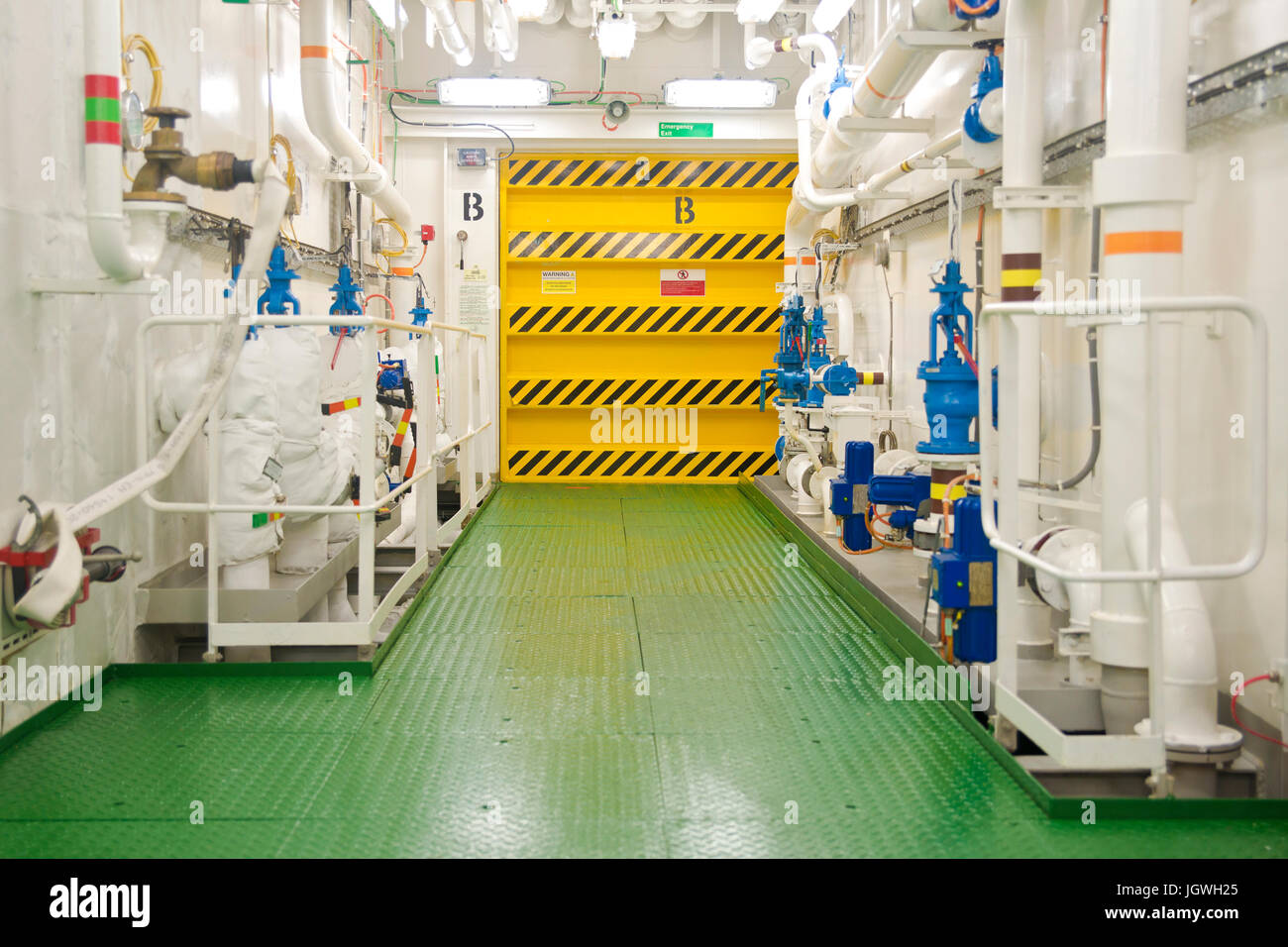
The cruise ship engine room is usually located on the lowest deck. Ships designers have historically put the heaviest equipment as low as possible, and nothing is heavier than an engine. Because engines are so big, they can sometimes take up three whole decks. Because the pistons are fired by a consistent flow of electricity rather than burning fuel, they move at the most efficient speed. Electricity is also used to pump cool seawater through the engines to cool them and prevent overheating.


No comments:
Post a Comment